]
Download the Schedule III Roadmap Deck
This post matches our on-camera slide deck: the mandatory steps, the controlling statutes, and realistic timing ranges. Drop your email in the form below and we’ll send it to you.
Not legal advice. Educational overview for operators, investors, and professionals.
Where the rescheduling process stands right now
 DOJ/DEA have already taken the “proposal” step. The proposed rule to move marijuana from Schedule I to Schedule III was published on May 21, 2024 in the Federal Register. You can read it here: DOJ/DEA proposed Schedule III rescheduling rule (May 21, 2024).
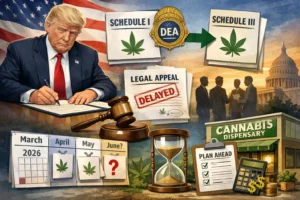
After the comment period closed in July 2024, the process moved into the hearing phase. DEA scheduled a hearing on the merits to begin on January 21, 2025, but the hearing did not proceed as planned. The hearing was postponed and the matter was placed in a stay posture due to an interlocutory appeal inside the administrative proceeding. As of early January 2026, the latest public status update indicates that the interlocutory appeal is still pending and that a briefing schedule has not been set.
That is the practical choke point. Until the appeal clears and the hearing calendar restarts, the process cannot reach the ALJ recommendation stage or the Administrator’s final order stage.
The laws that control rescheduling (and why it takes so long)
People talk about “DEA rescheduling” as if it is a single decision. It is not. This action is constrained by multiple layers of mandatory law, and those layers create time floors even in the fastest scenario.
1) Controlled Substances Act (CSA)
The CSA provides the authority and criteria for rescheduling. The key statutory hooks are 21 U.S.C. § 811 (rescheduling authority and factors) and 21 U.S.C. § 812 (schedule criteria, including Schedule III standards).
2) Formal, on-the-record hearing framework (APA)
This is not ordinary notice-and-comment rulemaking. Once the matter is set for an “on the record” hearing, the formal hearing framework under the Administrative Procedure Act applies (5 U.S.C. §§ 556–557). In plain English, the process starts behaving like a mini-trial: testimony, exhibits, objections, cross examination, and a transcript.
3) DEA hearing rules (the ALJ → Administrator pipeline)
DEA’s administrative hearing procedures live in 21 CFR Part 1316 (Subpart D). Those rules matter because they define the required sequence: hearing, record, ALJ report and recommended decision, exceptions, certification of the record, and then the Administrator’s final order and final rule.
4) Congressional Review Act (CRA)
Even after a final rule is published, the CRA adds a separate clock. The final rule must be submitted to Congress and GAO, and if it is deemed a “major rule,” the CRA imposes a minimum delay before it can take effect (5 U.S.C. §§ 801–804).
5) Judicial review
After the final decision, parties may seek judicial review under 21 U.S.C. § 877. This does not automatically stop the rule, but it does create stay risk if challengers ask a court to pause the effective date.
The step-by-step checklist to “effective Schedule III”
If you’re making decisions for a cannabis company, the only timeline that matters is the timeline to an effective final rule. Here is the practical checklist from “stuck” to “effective.”
- Administrator resolves the interlocutory appeal so the stay can lift and the hearing can restart (21 CFR § 1316.62).
- ALJ hearing on the merits occurs and the evidentiary record is built (5 U.S.C. §§ 556–557; 21 CFR Part 1316).
- Post-hearing briefing + proposed findings are submitted (21 CFR § 1316.64).
- ALJ issues a report and recommended decision for the Administrator (21 CFR § 1316.65).
- Exceptions period runs and the record is certified to the Administrator (21 CFR §§ 1316.66 and 1316.65(c)).
- Administrator publishes the final order / final rule in the Federal Register and sets an effective date (21 CFR § 1316.67; APA effective-date baseline in 5 U.S.C. § 553(d)).
- CRA submission occurs and, if the rule is “major,” the CRA effective-date runway applies (5 U.S.C. §§ 801 and 804).
Notice what is not on that list: press releases, political statements, executive orders, and “sources familiar with the matter.” None of those flip the legal switch. The legal switch flips on the final rule’s effective date.
Timing Floors & Planning Ranges (Table)
The table below is designed for operators and investors who need a realistic planning framework. These are not deadlines. They are a blend of (a) hard minimum clocks that exist in the rules and (b) typical ranges seen in contested federal administrative proceedings.
| Step | Authority (Statute / Rule) | Hard Minimum Floor | Practical Planning Range (Estimate) |
|---|---|---|---|
| Clear the interlocutory appeal | 21 CFR § 1316.62 | No fixed statutory deadline | 1–6 months if prioritized; 6–12+ months if contested |
| Hearing on the merits | 5 U.S.C. §§ 556–557; 21 CFR Part 1316 | Depends on ALJ calendar | 1–3 months (often multiple hearing days spread out) |
| Post-hearing briefs & proposed findings | 21 CFR § 1316.64 | Set by ALJ order | 30–60 days after evidentiary hearing closes |
| ALJ report & recommended decision | 21 CFR § 1316.65 | No fixed statutory deadline | 30–90 days after briefing closes |
| Exceptions period | 21 CFR § 1316.66 | 20 days (minimum window) | About 3–5 weeks, depending on filings |
| Record certified to Administrator | 21 CFR § 1316.65(c) | Not less than 25 days after service of ALJ report | Typically 3–6 weeks after ALJ report service |
| Final order / final rule published | 21 CFR § 1316.67 | No fixed statutory deadline | 1–4 months after certification (drafting + publication) |
| Effective date after publication | 21 CFR § 1316.67; 5 U.S.C. § 553(d) | Typically ≥ 30 days unless an exception is invoked | 30–90+ days, depending on the final rule’s effective-date choice |
| CRA “major rule” runway | 5 U.S.C. §§ 801 and 804 | 60 session days (if designated “major,” measured from statutory triggers) | 60–90+ days depending on submission timing and congressional receipt and time in session |
| Judicial review petition window | 21 U.S.C. § 877 | 30 days to file petition | Stay risk: weeks to months if a stay is granted (unpredictable) |
CRA “major rule” explained in plain English
Under the CRA, “major” does not mean “politically important.” It is a legal definition. A “major rule” is one that OMB/OIRA determines is likely to have impacts such as a $100,000,000+ annual effect on the economy, major cost/price effects, or significant adverse impacts on competition, employment, investment, innovation, or competitiveness (5 U.S.C. § 804(2)).
If the final Schedule III rule is designated “major,” there is a mandatory effective-date runway. The practical takeaway is simple: even after the final rule is published, the effective date is not immediate in the major-rule scenario.
What Schedule III changes (and what it doesn’t)
Schedule III would be a massive federal shift, but it is not federal legalization. It does not automatically turn state dispensaries into federally compliant pharmacies, and it does not create interstate commerce by itself. It does, however, change risk, research logistics, and business planning across the industry.
If you want a plain-language explanation of how Schedule III affects operators, read our deeper guide: what Schedule III means for cannabis businesses.
The biggest reason operators care is taxes. 280E is tied to Schedule I and Schedule II controlled substances. If marijuana becomes Schedule III, the 280E framework no longer matches the federal schedule classification in the same way. If you want the cleanest breakdown of the 280E problem and why it matters, start here: IRC 280E and cannabis taxes explained.
If your company needs help applying this timeline to tax planning, contracts, compliance posture, deal timing, or risk management, contact our team here: talk with a cannabis business lawyer about your Schedule III plan.
So when will Schedule III actually be effective?
As of January 2026, the correct way to think about timing is in ranges, because most major steps in this process have “as soon as practicable” language rather than firm deadlines.
Fast scenario (aggressive)
If the interlocutory appeal clears early in 2026, the hearing could restart and run in mid-2026, with post-hearing briefing and the ALJ recommendation later in 2026, followed by Administrator publication and the CRA runway. In that scenario, an effective date in early-to-mid 2027 is plausible.
Likely scenario (planning baseline)
If the appeal and hearing calendar drift, the Administrator’s final order is more likely to land in 2027, followed by the CRA runway. In that scenario, an effective date in late 2027 is a reasonable planning assumption.
Slow scenario (procedural fights + stay risk)
If the procedural disputes continue and/or litigation produces a stay of the effective date, 2028 or later becomes possible.
FAQ
When will marijuana be Schedule III?
Marijuana becomes Schedule III only when DOJ/DEA publish a final rule and the effective date arrives. Based on the remaining steps and minimum timing floors, early-to-mid 2027 is a plausible fast scenario, late 2027 is a reasonable planning baseline, and 2028+ is possible if the process stays stalled or a court stay blocks the rule.
Does the ALJ have to issue a recommendation before the DEA Administrator acts?
In the DEA hearing process for this type of matter, the presiding officer issues a report with recommended findings, conclusions, and a recommended decision, and the parties have an opportunity to file exceptions before the record is certified to the Administrator. The Administrator’s final order comes after that record is certified.
What is a “major rule” under the Congressional Review Act?
A “major rule” is defined by law. It generally covers rules OMB/OIRA expects to have a $100,000,000+ annual economic effect or major cost/price impacts or significant adverse effects on competition, employment, investment, productivity, innovation, or competitiveness. If the final Schedule III rule is designated major, the CRA imposes a minimum effective-date delay.
Can Congress block rescheduling under the CRA?
The CRA creates a process for Congress to attempt to disapprove rules via a joint resolution. Whether such an effort succeeds depends on the votes in both houses and whether the resolution becomes law. Separate from that political question, the CRA can still add timing runway for “major rules.”
Can courts stop the Schedule III rule?
A lawsuit does not automatically stop a rule. But challengers can ask a court to stay the rule’s effective date while litigation proceeds. Stay outcomes are fact-dependent and unpredictable, but they are a real timing risk in high-stakes federal rulemaking.