The THCa lawsuit wave has officially begun. In January 2026, a coalition of 20+ licensed Missouri cannabis operators filed a coordinated civil action against dozens of smoke shops selling THCa flower as “legal hemp.” Their argument is straightforward: these products are marijuana disguised as hemp, and selling them without a license is both a felony and unfair competition. If you hold a cannabis license and THCa shops are eating into your revenue, this is the litigation playbook you need to understand.
Here is everything you need to know about the THCa lawsuit strategy, the science behind the legal argument, and how licensed operators in any state can use the courts to protect their businesses before the federal hemp definition changes take effect in November 2026.
What’s in This Guide
- The Compliance Tax: Why Licensed Operators Are Losing
- What Is THCa, Really?
- The Total THC Standard Is Federal Law
- The Missouri Coalition THCa Lawsuit
- The Legal Argument: Unfair Competition
- Quantifying the Damage
- The Goal: Injunctive Relief
- The Litigation Protocol: Buy, Test, Litigate
- Scaling Beyond Missouri
- The November 2026 Deadline
- Why Litigation Wins Over Legislation
- Your Immediate Next Steps
- FAQs
The Compliance Tax: Why Licensed Operators Are Losing
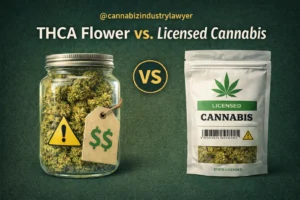
If you hold a cannabis license, you already know the math does not add up. You are paying tens of thousands of dollars annually just for the privilege of operating legally, while THCa smoke shops down the street pay nothing and sell what is chemically the same product. This is the core of every THCa lawsuit being filed right now.
Here is what licensed operators are required to do that THCa retailers completely bypass:
Licensed Operators Bear the Full Compliance Burden
- $28,138+ in annual cultivation fees and $7,878+ for retail licensing
- 6% excise tax plus sales tax on every transaction
- Mandatory security systems including vaults, cages, and HD camera surveillance—easily $38,000 or more for the initial lease alone, plus ongoing monthly costs
- METRC seed-to-sale tracking for every plant and every product
- Restricted banking limited to cash and debit transactions, with monthly fees of $500 or more just for basic treasury services
- Regular regulatory inspections and compliance audits
Hemp Smoke Shops Pay None of That
- $0 in license fees
- No excise tax
- Full credit card processing because there is no cannabis merchant code restriction
- FedEx and UPS shipping direct to consumer
- No tracking, no security mandates, no regulatory oversight
- Standard retail shelves instead of vaults
This is not just annoying. It is structural, actionable unfair competition. And it is exactly why the THCa lawsuit strategy is gaining momentum in states across the country.
What Is THCa, Really?
THCa (tetrahydrocannabinolic acid) is the raw, unheated form of THC found in the cannabis plant. It is the precursor to delta-9 THC, which is the controlled substance. According to the DEA, THCa is simply marijuana that has not been lit on fire yet.
Here is the chemistry: when you apply heat to THCa—whether by smoking a pre-roll, vaping, or baking—the acid group (the “a”) pops off through a process called decarboxylation. What remains is delta-9 THC, the federally scheduled drug. This conversion is not a possibility. It is a chemical inevitability. The only intended use for THCa flower sold in pre-rolls at smoke shops is to be smoked, which converts it into the controlled substance.
The Loophole That Created the Problem
The 2018 Farm Bill defined hemp as cannabis containing no more than 0.3% delta-9 THC on a dry weight basis. But it said nothing about THCa. And it required compliance testing to occur no more than 30 days before harvest, which locked in the THC measurement at a point when the plant had not yet produced most of its cannabinoids. The vast majority of cannabinoid production occurs in the final four weeks of flowering, well after that compliance test.
The result was a loophole large enough to drive an entire unregulated industry through. Sellers labeled high-THCa flower as hemp because the delta-9 number on the certificate of analysis (COA) came in under 0.3%. They conveniently ignored that the THCa content would push total THC to 20% or higher once consumed as intended.
The Total THC Standard Is Federal Law
The federal government has made its position clear: total THC is the standard, and THCa counts. This is the legal foundation of every THCa lawsuit being filed.
USDA Guidance
The USDA federal guidance requires that hemp compliance testing use post-decarboxylation methods where total THC accounts for the conversion of THCa. This means testing must measure what the product actually becomes when used, not just what it looks like sitting on a shelf.
DEA Confirmation (May 13, 2024)
On May 13, 2024, the DEA confirmed in a letter that for hemp-definition enforcement, delta-9 THC testing must account for THCa via post-decarboxylation methods. This was not a suggestion. It was the federal enforcement agency stating its interpretation of the law.
United States v. Defendant with Maine Medical License (November 2025)
In November 2025, the Department of Justice prosecuted a case in Maine where the defendant tried to argue that THCa content meant the seized product was legally hemp. The court rejected this argument. The motion to suppress evidence was denied, and the court held that if a product tests above 1% total THC by gas chromatography, the federal government does not consider it hemp. Period.
The Takeaway for Your THCa Lawsuit
A certificate of analysis claiming “0.3% delta-9 THC” is worthless in court if it ignores THCa conversion. The COAs that THCa retailers rely on are, in many cases, junk lab tests that deliberately measure only delta-9 rather than total THC.
The Missouri Coalition THCa Lawsuit
In January 2026, a coalition of 20+ licensed Missouri cannabis companies filed a coordinated THCa lawsuit in the Circuit Court of St. Louis County. The case targets dozens of unlicensed smoke shops and vape stores selling THCa flower. As reported by the Missouri Independent, the lawsuits target nearly 40 stores in St. Louis County and 17 businesses in the Kansas City area.
The Plaintiffs
The plaintiffs include well-known Missouri cannabis brands operating state-licensed cultivation, manufacturing, and dispensary facilities. Companies like 5150 Processing, 3 Fifteen Primo Cannabis, Blue Sage Cannabis, Clovr, Feel State, Greenlight Cannabis, Heya, Vertical Cannabis, and more. These are operators who have invested millions in licenses, compliance, security, and infrastructure.
The Defendants
The defendants are a long list of smoke shops, vape stores, and tobacco retailers selling THCa flower products. The caption alone reads like a phone book—a clear sign of a coordinated, industry-wide legal action.
Why This THCa Lawsuit Matters
This is the proof-of-concept case. Missouri’s licensed cannabis industry tried the legislative route for three consecutive sessions and got nowhere—the hemp lobby had too much money and too few regulations, giving them enormous free cash flow to spend on lobbyists. The THCa lawsuit strategy represents a pivot from asking the government for help to taking direct legal action.
The Legal Argument: Unfair Competition
The central THCa lawsuit theory is unfair competition. The argument breaks down into three elements:
The Act
The defendants are trafficking a Schedule I controlled substance (a Class A felony) disguised as hemp. When you test THCa flower using gas chromatography or total THC analysis, it consistently comes back at 15-25% delta-9 THC—well above the 0.3% threshold.
The Motive
By labeling the product as hemp, defendants bypass the entire regulatory regime: no license fees, no excise taxes, no security mandates, no seed-to-sale tracking, no compliance testing. This saves them hundreds of thousands of dollars annually.
The Tort
This creates an illegal competitive advantage that causes specific, quantifiable financial harm to licensed operators. The key strategic insight is this: we are not asking the court to enforce criminal law. We are asking for relief from business damages caused by criminal acts. This is a civil tort action, not a criminal prosecution.
Quantifying the Damage
Every THCa lawsuit needs to demonstrate specific damages. Here is how the compliance cost disparity breaks down between licensed operators and unlicensed THCa retailers:
License Renewal Fees
Licensed cultivation operations pay $13,506 annually. Retail dispensaries pay $7,878. THCa retailers pay $0.
Testing Costs
Licensed operators pay an average of $400 per lot for mandatory lab testing through accredited facilities. THCa retailers either skip testing entirely or rely on junk COAs that cost nothing and test only for delta-9.
Security Infrastructure
Vaults, cages, HD cameras, alarm systems—a dispensary security system can easily run $38,000 to lease initially, with substantial monthly fees after that. THCa retailers use standard retail shelving.
Banking and Operations
Licensed operators are limited to cash-only banking with monthly fees of $500 or more, plus $1,500 or more for cash handling services. THCa retailers accept credit cards through standard retail merchant codes and have full access to normal banking.
The Missouri coalition is seeking tens of millions of dollars in damages, plus punitive damages exceeding $75,000. But the money is secondary to the real goal.
The Goal: Injunctive Relief
The primary objective of the THCa lawsuit strategy is injunctive relief—a permanent injunction. That means a court order legally barring the defendants from marketing, distributing, or selling any product with a post-decarboxylation total THC content above 0.3%.
In plain language: stop. The court tells them they cannot do it anymore. That is what an injunction is. The monetary damages matter, but the real strategic win is shutting down the business model entirely.
The Litigation Protocol: Buy, Test, Litigate
If you are a licensed operator considering a THCa lawsuit in your state, here is the evidence-gathering protocol:
Step 1: The Buy
Purchase THCa products from the target retailers as a normal retail customer. Preserve everything: receipts, packaging, marketing claims, any signage claiming the product is “legal hemp.” Maintain strict chain of custody from the moment of purchase. Document the date, time, location, and the name of the person who sold it to you.
Step 2: The Test
Send the purchased products to a credible, independent lab. Request gas chromatography (GC) testing or total THC analysis. Gas chromatography is the silver bullet because it uses heat during analysis, which converts THCa to delta-9 THC during the test itself. The result legally proves the product is marijuana, not hemp. Labels do not beat chemistry.
You can also use HPLC (high-performance liquid chromatography) and simply add the THCa and delta-9 THC values together, applying the standard conversion factor to account for the molecular weight of the acid group.
Step 3: Litigate
File the THCa lawsuit. The primary claim is typically unfair competition or deceptive trade practices. Secondary claims can include:
- False advertising — marketing a controlled substance as “legal hemp”
- Public nuisance — distributing unregulated intoxicating substances in the community
- Common-law misrepresentation — knowing misstatement of what the product is
The strategy is to secure a temporary restraining order (TRO) or preliminary injunction quickly, based on the lab results. Once you have irrefutable gas chromatography results showing 20%+ delta-9 THC, the evidence speaks for itself.
Scaling Beyond Missouri
The THCa lawsuit model is not limited to Missouri. The chemistry is universal: THCa converts to delta-9 THC in every state. The USDA and DEA definitions apply nationwide. While the specific legal claims will vary by jurisdiction—whether it is unfair competition, consumer protection, or fraud—the core argument remains the same everywhere: a business avoiding compliance mandates to sell a controlled substance is harming the compliant market.
States where this THCa lawsuit approach is especially relevant include those with both legal cannabis programs and unregulated THCa sales: Illinois, Ohio, Michigan, Colorado, Oregon, and others. MJBizDaily reports that marijuana operators across the country are not waiting for the federal hemp ban to halt THCa sales—they are turning to the courts now.
Check the consumer protection, deceptive trade practices, and unfair competition statutes in your state. Many states have robust frameworks that give licensed operators standing to bring exactly this kind of action.
The November 2026 Deadline
In November 2025, Congress passed a provision in the FY2026 Agriculture Appropriations Act that redefines hemp to include total THC (including THCa) in the 0.3% threshold. This effectively bans most smokable hemp flower and THCa products. The law takes effect November 12, 2026.
But November is nine months away. Q4 is peak retail season, and holiday sales are at risk. There are no must-pass bills between now and November that could change this timeline. The ag bill has been funded, three out of four senators voted for it, and the President signed it.
Waiting for November means losing nine more months of revenue to unlicensed competition. That is why the THCa lawsuit strategy is the right move right now—you do not have to wait for the government to act when you can take direct legal action through the courts.
Why Litigation Wins Over Legislation
Why are licensed operators choosing a THCa lawsuit over lobbying the legislature? Three reasons:
Speed
Civil litigation moves faster than regulatory bureaucracy. A temporary restraining order can be filed and heard within days. Compare that to waiting for a legislative session, committee hearings, floor votes, and a governor’s signature.
Science
Gas chromatography testing provides objective, irrefutable evidence. Once you test THCa flower and it comes back at 20% delta-9 THC, there is no political spin that changes the chemistry. The evidence speaks for itself.
Cost-Sharing
Coalition lawsuits spread the legal costs. In Missouri, the attorney sends one invoice and divides it by 20 plaintiffs. That makes the per-operator cost manageable, even for smaller licensed businesses. You are not fighting alone—you are pooling resources with every operator who is being hurt by the same problem.
Your Immediate Next Steps
If you are a license holder and want to explore a THCa lawsuit strategy, here is where to start:
- Identify your top five problem stores. Which THCa smoke shops are closest to your dispensary and stealing the most revenue?
- Execute the buy phase. Go in as a regular customer, purchase their THCa flower products, and preserve the chain of custody on everything.
- Get the lab results. Send the products to an accredited lab for gas chromatography or total THC analysis.
- Build your coalition. Talk to other licensed operators in your market. The more plaintiffs, the lower the per-operator cost and the stronger the message.
- Contact a cannabis litigation attorney. You need counsel experienced in both cannabis regulatory law and civil litigation to structure the claims properly for your jurisdiction.
Do not ask the government for special treatment. Present the court with proof.
Frequently Asked Questions
What is a THCa lawsuit?
A THCa lawsuit is a civil legal action filed by licensed cannabis operators against unlicensed retailers selling THCa hemp flower. The lawsuits typically allege unfair competition and deceptive trade practices, arguing that THCa products are chemically equivalent to marijuana and that selling them without a license creates an illegal competitive advantage.
Is THCa flower actually marijuana?
According to the DEA and federal courts, yes. THCa is the raw precursor to delta-9 THC. When tested using gas chromatography or total THC methods, THCa flower routinely shows 15-25% delta-9 THC content, far exceeding the 0.3% legal threshold for hemp. The DEA confirmed in a May 2024 letter that THCa must be accounted for in hemp compliance testing.
Can licensed operators sue THCa sellers in any state?
The legal framework varies by state, but the core argument applies nationwide because THCa-to-THC chemistry is universal and federal definitions from the USDA and DEA apply everywhere. Most states have unfair competition, consumer protection, or deceptive trade practices statutes that could support a THCa lawsuit. Operators should consult with a cannabis litigation attorney familiar with their state’s specific laws.
What evidence do I need to file a THCa lawsuit?
You need lab results from an accredited, independent laboratory showing that the THCa products exceed 0.3% total THC when tested via gas chromatography or total THC analysis. You also need to maintain a strict chain of custody—documenting the purchase, preserving receipts and packaging, and ensuring the product is not tampered with before testing.
What happened with the Missouri THCa lawsuit?
In January 2026, a coalition of 20+ licensed Missouri cannabis companies filed coordinated lawsuits targeting nearly 40 smoke shops in St. Louis County and 17 businesses in the Kansas City area. The plaintiffs are seeking tens of millions of dollars in damages plus a permanent injunction to stop THCa sales. The case is still in its early stages as defendants are being served.
When does the federal THCa ban take effect?
The FY2026 Agriculture Appropriations Act redefines hemp to include total THC (including THCa) in the 0.3% threshold. The new definition takes effect November 12, 2026. Until then, the 2018 Farm Bill definition technically remains in force, which is why licensed operators are using the THCa lawsuit strategy now rather than waiting for federal enforcement.
The Bottom Line
The THCa lawsuit is the most powerful tool available to licensed cannabis operators right now. The science is irrefutable—gas chromatography does not lie. The legal framework is solid—unfair competition and deceptive trade practices give you a viable cause of action. And the Missouri coalition has provided the proof of concept for every other state to follow.
You spent hundreds of thousands of dollars on licenses, security, compliance, and testing. The smoke shop across the street spent nothing and sells the same product. That is not competition—it is a structural advantage built on regulatory avoidance. And the courts are the fastest way to fix it.
If you are a licensed operator who wants to explore a THCa lawsuit strategy, contact Thomas Howard at Cannabis Industry Lawyer to discuss your options. Do not wait for November. Act now.