Nebraska medical cannabis law (2026): rules, risks, and how to stay compliant
Nebraska’s medical cannabis program is a classic “new-regulator” environment: the law  is newly enacted, the rules are actively being operationalized, and applicants are building real businesses while the ground is still settling. In that environment, legal success is not about writing the most inspiring narrative. It’s about avoiding disqualifying mistakes, structuring ownership and control cleanly, and submitting a package that remains defensible even if the rulebook tightens or litigation accelerates.
This hub is written from a lawyer’s perspective. The point is risk management: (1) understand who has authority, (2) understand what can change quickly, (3) structure for compliance, and (4) document your compliance in a way that survives scrutiny.
Start with authority: who regulates and why that matters
In a developing program, applicants waste time arguing about what the rules should be. You need to start with what the law says about who has power. Nebraska’s statute vests regulatory authority over medical cannabis establishments in the Medical Cannabis Commission. That means the Commission’s interpretations, application instructions, and enforcement posture will drive outcomes until a court (or a later legislative change) says otherwise.
Single external reference for this page (use once): Neb. Rev. Stat. § 71-24,110.
Why you should care: when authority is centralized, “close enough” compliance becomes expensive. A centralized regulator can apply consistency across applicants and deny for technical defects without negotiating. Your application should be built as if it will be reviewed by someone who has denied dozens already—and is looking for reasons to reduce the pool.
Legal framework applicants should internalize
Think of Nebraska medical cannabis law as a layered system:
- Layer 1: The initiative statute. The statute sets the Commission’s core authority, broad program structure, and the limits that rulemaking can’t ignore.
- Layer 2: Commission regulations and guidance. This is where definitions, application requirements, licensing categories, and compliance obligations live in practice.
- Layer 3: Implementation (forms, instructions, review practice). This is where applicants get surprised: the “how” (formatting, proof standards, submission mechanics) creates real disqualification risk.
- Layer 4: Litigation / political pressure. New programs attract challenges. Even if you don’t litigate, your structure must tolerate uncertainty without collapsing.
Applicant posture: you are not writing for a friendly audience. You are building a record that must be defensible if challenged by (a) a regulator, (b) a competitor, (c) a public-records requester, or (d) a court reviewing agency action.
Rulemaking uncertainty: how to build “update-ready” compliance
In January 2026, the highest-risk mistake is locking a structure (ownership, financing, management, IP licensing, services agreements) that cannot be adjusted quickly if the Commission clarifies or tightens its rules. “Update-ready” compliance means you can revise your application package without rewriting your entire deal stack.
Build your compliance system like this:
- Assumptions Register: list every statement in the application that depends on a definition, cap, prohibition, or procedural rule that might change. (Example categories: eligibility, ownership thresholds, residency, vertical integration rules, product or operational prohibitions.)
- Modular agreements: structure agreements so that if one provision becomes problematic, you can amend surgically without breaking the whole relationship.
- Proof standards: identify what the Commission is likely to want as proof (not just what you prefer to provide). Then gather it early.
- Version control: one “source of truth” for names, ownership percentages, addresses, and entity relationships.
Legal payoff: if the rules move, you update. If your structure is sloppy, you’re stuck—or you change late and introduce contradictions.
The disqualifiers that don’t need to happen
Most applicant losses are avoidable. In new licensing programs, the Commission’s easiest tool is technical disqualification. If the Commission can disqualify cleanly on objective defects, it reduces the pool without fighting about subjective scoring.
Common avoidable failure modes:
- Inconsistency: ownership percentages or roles don’t match across documents.
- Missing exhibits: you reference proof but don’t include it (or include the wrong version).
- Overpromising: you claim compliance measures you cannot operationalize (and can’t document).
- Hidden control: management or services agreements effectively transfer control while “ownership” stays local.
- Bad paper trail: conflicting addresses, mismatched entity names, unsigned documents, or undated commitments.
Rule of thumb: anything that looks like “we’ll fix this later” will be treated as “not qualified.”
Ownership and control: the compliance trapdoor
New cannabis programs tend to police ownership and control aggressively. Not because regulators enjoy it, but because control drives responsibility—and because bad actors historically hide behind nominal owners.
Two concepts to keep distinct:
- Equity ownership: who owns the entity economically.
- Control and governance: who can appoint/remove managers, control budgets, approve key contracts, veto decisions, or direct operations.
Where applicants get hurt: they think “we kept equity local” solves compliance. Then the services agreements, IP licensing, management contracts, or debt covenants effectively hand operational control to non-disclosed parties. Even if the deal is commercially “normal,” it can create a regulatory problem if it functions like control.
Practical legal advice: before you sign any “help us win” agreements, map out:
- Who controls the bank account and budget approvals?
- Who can hire/fire key personnel?
- Who can sign leases and major vendor contracts?
- Who controls compliance reporting and corrective action?
- What happens on default of a note or service agreement?
If the answer is “a non-disclosed party can effectively run the shop,” you have a predictable disqualification fight—or worse, a post-award enforcement event.
Disclosures and consistency: one contradiction can sink you
Licensing agencies are not impressed by volume. They are impressed by internal consistency. The fastest way to lose credibility is to submit a file where basic facts don’t line up across:
- entity formation records and operating agreements,
- ownership and control disclosures,
- financing documents,
- management/services/IP agreements, and
- the narrative sections describing “who does what.”
Operate like a litigator: assume every statement can be cross-examined. Then write the application so it survives cross-examination without needing your oral explanation.
Application posture: write like a regulator will audit you
Applicants often write as if the Commission is a customer. It is not. The Commission is a gatekeeper and (in practice) an auditor. You want your application to read like:
- Clear: an examiner can find answers quickly.
- Provable: each meaningful claim points to a specific exhibit.
- Operationally coherent: compliance is assigned, documented, and enforced through routine practice.
- Defensible: nothing depends on “trust us” or “industry standard” assertions without support.
Style guidance: short paragraphs, checklists, and requirement-mapped exhibits beat flowery prose. Agencies do not award points for adjectives.
Enforcement reality: don’t build a plan that requires mercy
In the first licensing cycle, regulators are under pressure to prove competence and protect public safety. That means enforcement can be strict. Your compliance program should not depend on “we’ll train later” or “we’ll hire someone to do that once we open.”
Build compliance into your operating architecture:
- training logs and refresher cadence,
- audit checklists,
- incident response procedures with named owners,
- document retention and version control,
- clear segregation of restricted areas and access controls.
Applicants who win and then stumble usually stumble here: they described a compliance machine but built a startup that improvises.
What applicants should do now (January 2026 checklist)
If you are building an application package right now, here is the risk-managed sequence that prevents “late-stage rewrites”:
- 1) Confirm authority + current rules. Use primary sources and record your assumptions in writing.
- 2) Lock the entity and governance structure. Make sure roles, voting, manager authority, and veto rights are coherent and defensible.
- 3) Build the disclosure map. List every person/entity with any plausible claim to ownership, control, profit participation, or operational authority—and decide how it must be handled.
- 4) Draft/collect the “proof layer.” If you claim readiness, prove it: resumes, SOPs, site control documentation, compliance program artifacts.
- 5) Write narrative last. The narrative should be a guided tour of your exhibits, not a substitute for them.
- 6) QA for contradictions. Two passes: completeness and internal consistency. Treat inconsistencies as disqualifiers.
Legal payoff: this sequence makes your file resilient. If a rule changes, you update one module rather than rewriting everything.
Deeper guides (supporting pages)
Use the pages below to go deeper on the three areas that drive legal outcomes: requirements, Commission rulemaking process, and litigation risk.
- Nebraska cultivation license application (2025)
- Nebraska dispensary license requirements
- Nebraska Medical Cannabis Commission rules
- Nebraska medical cannabis litigation
Talk to counsel before you lock the structure
Make the structure defensible before you submit
If you want to stay qualified, get the ownership/control, disclosure map, and agreement stack right before you finalize the package. Our team has won licenses and owns/operates dispensaries in other states, and we use that operating reality to build compliant, regulator-friendly applications that don’t collapse under scrutiny.
FAQs
- What does “Nebraska medical cannabis law” cover for applicants?
It covers the statute creating the program, the Commission’s rules and guidance, and the compliance obligations that govern licensing and operations. - Why does Commission authority matter so much in a new program?
Because centralized authority means the Commission’s interpretations and application standards drive outcomes unless and until changed by a court or later law. - What is the biggest legal risk for applicants right now?
Submitting an application with structural defects (ownership/control, disclosures, agreement terms) that can’t be “explained away” after the fact. - Is it enough to keep equity local?
Not by itself. Agreements and covenants can create practical control even when equity remains local. - What does “hidden control” look like in practice?
Management or services agreements, financing covenants, or IP terms that effectively give a third party veto power or operational direction. - How should applicants handle rule changes while preparing?
Maintain an assumptions register, use modular agreements, and apply strict version control so updates don’t create contradictions. - What are the most common avoidable disqualifiers?
Inconsistencies across documents, missing exhibits, overpromising, and unclear control/disclosure mapping. - How detailed does the compliance program need to be pre-submission?
Detailed enough to show daily habits: who owns compliance tasks, how they’re documented, and how issues are corrected. - Why is internal consistency so important?
Agencies can disqualify objectively for contradictions. Consistency is the cheapest risk reduction you can buy. - Should applicants expect heightened scrutiny or challenges?
Yes. New programs attract scrutiny and disputes; your file should be defensible without oral explanation. - Does litigation stop the program automatically?
Not automatically. But litigation risk is real, and applicants should build timelines and contracts that tolerate uncertainty. - What is the best way to write the narrative sections?
As a guided tour of exhibits: clear, indexed, and provable—minimizing “trust us” assertions. - When should counsel get involved?
Before finalizing ownership, financing, and management agreements; those decisions create disqualification risk that is hard to fix later. - How can experienced operators help without creating control issues?
By providing clearly bounded advisory inputs and documented expertise without governance rights, veto power, or operational direction authority. - What is the fastest way to reduce legal risk this month?
Build a disclosure/control map, reconcile every document against it, and run a QA pass specifically designed to find contradictions.

New York Cannabis Dispensary Proximity Rule 2026
Your New York cannabis dispensary license just became simultaneously more valuable and more fragile. The proximity rule chaos that’s defined the state’s rollout since 2021 hit peak turbulence in 2025—and the 2026 regulatory landscape won’t stop moving. We’re talking Second Circuit constitutional rulings, OCM recalculating distances and putting 105 licensed
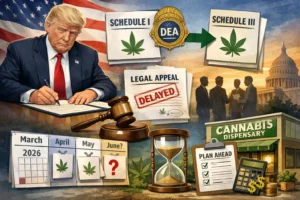
Trump Cannabis Rescheduling Order: What It Actually Does
On December 18, 2025, President Trump signed an executive order directing the Attorney General to expedite moving marijuana from Schedule I to Schedule III under the Controlled Substances Act. The internet celebrated like federal cannabis legalization had arrived. It had not. Three months later, marijuana is still a Schedule I
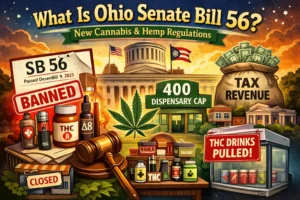
Ohio SB 56: What Cannabis Businesses Must Know (2026 Guide)
As of March 20, 2026, Ohio’s approach to cannabis regulation just got a whole lot more restrictive. Senate Bill 56 didn’t just tweak Issue 2—it basically hit the reset button on parts of what voters approved in 2023. If you’re operating a cannabis business in Ohio, running a hemp company,