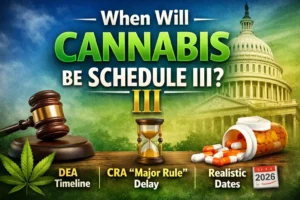
When marijuana moves to Schedule III, Indiana businesses will ask the same question: “So… can we finally operate legally?”
In Indiana, the honest answer is: not unless Indiana law changes. Federal rescheduling can change momentum, but it does not create an Indiana licensing window by magic.
1) Schedule III: a federal reclassification, not a permission slip
 The DEA’s proposal is explicit: even in Schedule III, manufacture, distribution, dispensing, and possession remain subject to CSA controls, and FDCA restrictions still apply to drugs containing marijuana.
Translation: Schedule III doesn’t “turn on” a state market. States still decide whether you can operate.
2) Indiana’s key nuance: legislative proposals can be contingent on federal scheduling
Indiana lawmakers have floated medical cannabis frameworks. One introduced proposal (Indiana SB 341) is bluntly structured: it contemplates medical cannabis after marijuana is removed as a federal Schedule I substance.
That kind of trigger matters for client acquisition: you can tell Indiana operators, truthfully, that federal movement can be a catalyst—but they still need an Indiana bill to pass, agencies to write rules, and an application process to open.
Indiana SB 400 (introduced) is another example of a proposed medical marijuana program framework conceptually (program creation, regulator, etc.).
3) What happens to “state markets” when Schedule III hits—especially in non-legal states like Indiana
Indiana doesn’t have an adult-use market to “convert,” so the near-term effects are mostly spillover:
- Pressure increases: border-state dynamics and legislative comparisons get louder.
- Hemp-derived THC chaos gets worse before it gets better: consumers keep buying intoxicating products; enforcement stays inconsistent.
- Serious capital waits for a real licensing pathway: big money prefers rulebooks, not vibes.
So the operator opportunity in Indiana is not “open a dispensary.” It’s “get positioned to apply the minute Indiana opens a program.”
4) The FDCA trap remains (and it’s the same trap in Indiana)
Even if Indiana passes a medical program, “FDA legality” is still a separate axis.
FDA’s position: THC/CBD generally can’t be sold as dietary supplements, and THC/CBD generally can’t be added to conventional food under existing FDCA pathways.
If you’re selling gummies/drinks/tinctures today as “wellness supplements,” you’re often building a business on:
- labeling and claims risk (unapproved drug claims),
- food/supplement exclusion risk, and
- copycat/child-appeal packaging risk (an enforcement magnet).
Schedule III does not fix that.
5) Indiana Schedule III cannabis application readiness: what winners will have done before applications open
A. Ownership + background-check hygiene
Indiana, like most states, will likely scrutinize:
- beneficial ownership,
- prior regulatory violations,
- capitalization sources.
If your structure is messy, you’ll burn time rewriting history under deadline.
B. Site strategy: zoning-first, optimism second
Secure sites with:
- zoning compatibility,
- buffer awareness,
- local political acceptance.
(If a town doesn’t want cannabis, your “perfect facility” is just an expensive disappointment.)
C. Compliance plan that reads like a regulated healthcare operation
Plan as if:
- inventory diversion is assumed,
- data reporting is mandatory,
- product recall is not hypothetical.
D. A product strategy that doesn’t bet the company on FDA ignoring you
Medical programs often permit ingestibles—but FDA rules still create federal friction. Build brand and labeling to survive the day enforcement becomes consistent.
6) FAQ (copy/paste for FAQ schema)
Does Schedule III make marijuana legal in Indiana?
No. Indiana law must authorize a program and licensing.
Could Schedule III trigger Indiana medical cannabis legislation?
It can increase momentum, and at least one introduced Indiana proposal (SB 341) is explicitly framed to operate after marijuana is removed from federal Schedule I.
Does Schedule III legalize CBD/THC gummies as supplements?
No. FDA’s position is that THC/CBD products generally can’t be marketed as dietary supplements or added to conventional food under current FDCA frameworks.
If Indiana opens applications, what will matter most?
Capitalization proof, ownership integrity, local approvals, and an operations plan that looks regulator-built.
CTA:
If you want a real shot at an Indiana cannabis license when applications open, the work is done before the bill passes: structure, site control, compliance narrative, and a bankable operating plan.