
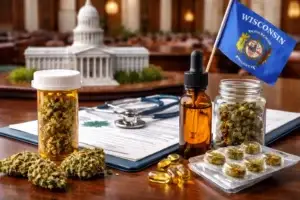
 Wisconsin medical cannabis bill SB 534 is moving again, and this time it’s not a symbolic gesture. The Wisconsin Senate Health Committee voted 4–1 to advance a Republican-led medical cannabis proposal sponsored by Senate President Mary Felzkowski and Sen. Patrick Testin.
If you want a clear read on what Wisconsin is actually doing, ignore the slogans and look at the structure: this Wisconsin medical cannabis bill is narrow, medicalized, and designed to survive political scrutiny. It’s not adult-use legalization. It’s not a broad “everyone gets a card” model. It’s a tightly controlled program meant to look like healthcare and behave like a regulated supply chain.
What’s happening in Wisconsin right now
- Legislative development: A GOP-sponsored medical cannabis proposal (SB 534, with an Assembly companion bill) advanced out of the Senate Health Committee on a 4–1 vote.
- Political signal: Leadership sponsorship suggests Wisconsin medical marijuana is no longer treated as untouchable in the Senate.
- Key bottleneck: The Wisconsin Assembly remains the harder lift; leadership has publicly expressed skepticism about the Senate version’s scope.
What the Wisconsin medical cannabis bill allows
1) Qualifying medical conditions
Under the proposal, eligibility is based on a defined list of serious conditions. As reported, the Wisconsin medical cannabis bill includes (among others):
- Cancer
- HIV/AIDS
- PTSD
- Seizure disorders / epilepsy
- Glaucoma
- Severe chronic pain
- Severe muscle spasms
- Severe chronic nausea
- Alzheimer’s disease
- Parkinson’s disease
- ALS
- Multiple sclerosis (MS)
- Inflammatory bowel disease (IBD)
- Tourette syndrome / chronic tic disorder
- Terminal illness (life expectancy under one year)
Why this matters: A closed qualifying-condition list is a common strategy to keep “medical cannabis” from becoming de facto adult-use by certification.
2) Allowed product forms (and the smoking prohibition)
The bill is built around non-smokable medical cannabis. Product forms described under the proposal include:
- Oils and tinctures
- Edibles and pills
- Concentrates
- Vaporized forms (non-combustible)
- Topicals (gels, creams)
- Patches
- Liquids
- Nebulizer-administered forms
Smokable cannabis is prohibited. That “no smoking” line is not accidental. It’s there to keep the Wisconsin medical cannabis bill framed as medicine rather than recreation.
3) No home grow
The proposal does not allow home cultivation. Patients cannot grow their own medical cannabis.
Why this matters: No home grow protects a regulated supply chain and reduces diversion arguments, but it can increase patient cost and reduce access.
4) Patient registration, caregivers, and renewal
The program is registry-based. Key features described include:
- Patients register with the state medical cannabis program.
- Registration runs on a multi-year cycle (commonly reported as two years), with low fees reported annually.
- Patients may designate up to three caregivers to purchase/possess on the patient’s behalf.
5) Pharmacist involvement and “medicalized” dispensing
The Wisconsin medical cannabis bill takes an unusually “clinical” approach at the dispensary level. Under the proposal:
- Dispensaries must employ pharmacists.
- Pharmacists consult with patients and recommend a daily dosage.
Why this matters: Pharmacist-driven dispensing increases political defensibility and oversight, but also increases operating costs and program friction.
6) Purchase limits (30-day to 90-day supply)
As described, patient purchases are limited to a supply model:
- Initially up to a 30-day supply
- Later up to a 90-day supply
7) PDMP reporting (Prescription Drug Monitoring Program)
The proposal requires reporting medical cannabis activity into Wisconsin’s Prescription Drug Monitoring Program (PDMP).
Why this matters: PDMP integration is a credibility move for skeptics, but it can raise patient privacy concerns and discourage participation.
8) Where possession and use are allowed (and penalties)
The proposal restricts possession and use largely to:
- A patient’s residence, and
- Travel between home and a dispensary
Violations described in reporting may be handled as civil penalties rather than criminal charges (for example, fines tied to documentation or where possession occurs).
What the bill does NOT do
- No adult-use legalization.
- No smokable flower.
- No home grow.
- No broad “doctor discretion” open-ended qualifying standard.
- No robust employment protections comparable to stronger medical cannabis states.
Translation: This is structured to be a controlled medical program, not a commercial cannabis marketplace.
Political reality: will it pass?
The committee vote is meaningful, but it does not guarantee passage. The main obstacle is the Assembly, where leadership has suggested the Senate approach may be too broad. In Wisconsin terms, that usually leads to one of three outcomes: (1) narrowing amendments, (2) a competing Assembly version, or (3) a stall that avoids forcing a tough floor vote.
What to watch next: whether Senate leadership schedules floor time, whether the Assembly introduces a tighter bill, and whether leadership ties medical cannabis to a public health or public safety package for political cover.
What this means for intoxicating hemp THC beverages
Even though SB 534 focuses on medical cannabis, it has downstream consequences for hemp-derived THC products. Once a state establishes a regulated cannabis pathway, regulators and lawmakers have a ready-made argument: THC should be sold through licensed channels with testing, labeling, age gates, and enforcement.
That framing makes it harder to defend intoxicating hemp THC beverages operating outside licensed cannabis systems. Put plainly: a regulated medical program doesn’t “save” intoxicating hemp. It makes the unregulated lane look less defensible and easier to restrict.
External sources (for readers who want the primary documents)
- Wisconsin Legislature bill documents and text (search SB 534)
- Wisconsin Department of Health Services (DHS)
- Wisconsin Department of Agriculture, Trade and Consumer Protection (DATCP)
- Wisconsin PDMP (Prescription Drug Monitoring Program)
Key takeaways
- The Wisconsin medical cannabis bill advanced out of committee on a 4–1 vote, with leadership sponsorship.
- The program is intentionally narrow: non-smokable products, no home grow, registry access, and pharmacist involvement.
- PDMP reporting and dosing controls emphasize a “medical” posture over a retail model.
- Assembly leadership skepticism remains the key obstacle to passage.
- Regulated medical cannabis makes intoxicating hemp THC beverages outside licensed channels harder to justify.
Disclaimer: This article is for informational purposes only and does not constitute legal advice. For advice regarding a specific situation, consult counsel licensed in the relevant jurisdiction.